
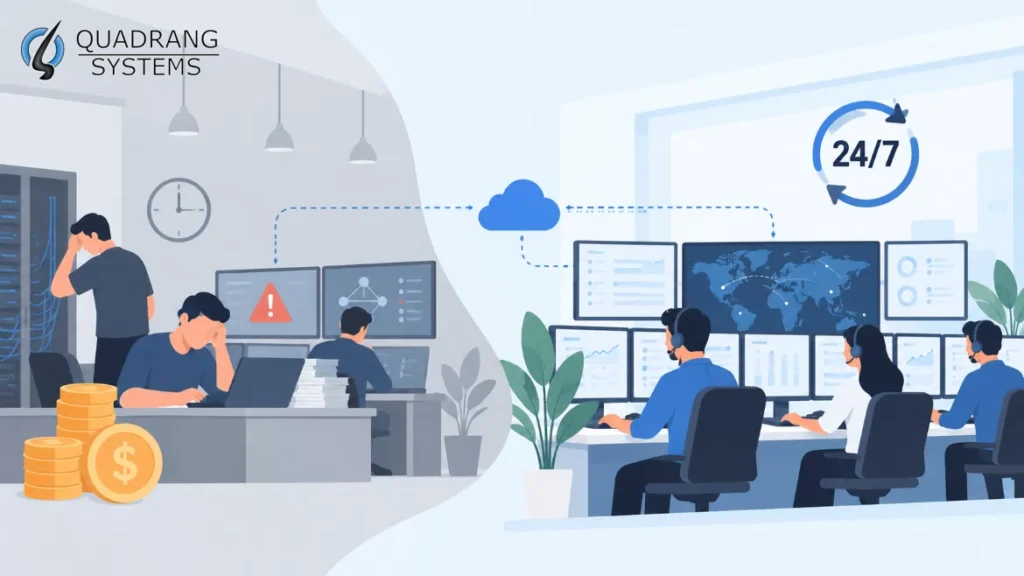
Outsourced NOC Services in 2026: Affordable Network Operations
Network infrastructure is now the backbone of every business. Hybrid work, multi-cloud architectures, AI workloads, and connected devices have made networks more complex than ever, and downtime costs more with each passing year. For many organizations in 2026, outsourced NOC services are the most practical way to get enterprise-grade network operations without enterprise-grade overhead.
Understanding Outsourced Network Operations Centers
An outsourced NOC is a partnership in which a specialized third-party provider handles your network monitoring, maintenance, and support. The provider offers round-the-clock surveillance of your infrastructure, proactive issue detection, incident response, and clear reporting, all backed by defined service level agreements.
Demand for these services keeps growing for three reasons. IT environments are more distributed and harder to manage than before. Skilled network engineers remain scarce and expensive to hire and retain. And leadership teams want predictable operating costs instead of heavy capital investment. For most organizations, a dedicated external team now delivers better results than a stretched in-house operation.
Core Components of Outsourced NOC Services
A modern outsourced NOC covers much more than uptime monitoring. The core capabilities typically include:
Real-Time Monitoring and Observability
Today’s NOC teams use full-stack observability platforms that combine network telemetry, application performance data, and cloud metrics. This lets them detect anomalies, performance degradation, and emerging threats before users notice a problem.
Incident Management
NOC engineers triage alerts, diagnose root causes, and resolve issues according to predefined escalation paths. A structured response process minimizes downtime and keeps the business running during critical events.
Configuration and Change Management
Network changes are planned, tested, documented, and rolled back safely if needed. Disciplined change control prevents the self-inflicted outages that remain one of the most common causes of network failures.
Reporting and Analytics
Regular reports on availability, latency, capacity, and security events give leadership the data to make informed decisions about infrastructure investment and optimization.
Strategic Advantages of Outsourcing Network Operations
Organizations that outsource their NOC in 2026 gain several clear advantages.
Cost Efficiency
Building an in-house 24/7 NOC means paying for shift coverage, training, certifications, tooling, and facilities. Outsourcing converts those fixed costs into a predictable service fee, and many organizations find the savings substantial. Exact figures depend on network size and scope.
Deep, Certified Expertise
Established NOC providers employ engineers with certifications and hands-on experience across many vendors, platforms, and environments. That breadth shortens resolution times and often stops small issues from becoming major outages.
Scalability and Flexibility
Whether you are opening new branches, migrating workloads to the cloud, or handling seasonal spikes, an outsourced NOC scales with you. You avoid the hiring delays and fixed capacity limits of an internal team.
Technology Excellence in Modern NOC Operations
The technology behind NOC services has changed significantly over the past few years.
AIOps and Agentic Automation
Leading providers now use AI-driven operations platforms that correlate thousands of alerts into a handful of actionable incidents, predict failures, and suggest or execute remediation. Agentic automation can resolve routine issues such as interface flaps, service restarts, and capacity alerts without human intervention. That speeds up response and frees engineers to focus on complex, high-impact problems.
Cloud-Native and Multi-Cloud Visibility
Enterprise networks now span data centers, branch offices, remote workers, and several cloud providers. Modern monitoring platforms provide unified visibility across all of them, so there are no blind spots between on-premises and cloud environments.
Secure Networking Architectures
SD-WAN, SASE, and zero trust frameworks are now standard parts of enterprise networks. A capable NOC monitors and manages these layers alongside traditional routing and switching, keeping performance and security aligned.
Security Considerations and Compliance
Security is inseparable from network operations. Modern NOC services incorporate behavioral analysis and anomaly detection that can flag suspicious traffic patterns that traditional tools miss, and the best providers work closely with security operations teams to speed up detection and response.
Compliance expectations have also grown. Reputable providers maintain certifications such as SOC 2 and ISO 27001 and support client obligations under sector-specific and regional frameworks. These include data protection laws, financial services resilience rules, and healthcare privacy requirements. When evaluating a provider, ask for audit reports and clear documentation of how your data and access are protected.
Future Trends and Innovations
Several trends are shaping where outsourced NOC services are heading beyond 2026.
Edge and Distributed Infrastructure
As more processing moves closer to users and devices, networks become more geographically dispersed. NOC providers are building specialized monitoring for edge sites, IoT deployments, and private 5G environments.
Network and DevOps Convergence
Integration with DevOps and CI/CD pipelines continues to deepen. Infrastructure-as-code and automated testing let network changes ship as quickly and safely as application releases.
Intent-Based and Software-Defined Networking
Intent-based networking and programmable infrastructure are changing how networks are configured and verified. NOC teams increasingly manage policies and outcomes rather than individual device commands.
Preparing for AI-Heavy Workloads
AI training and inference put new demands on bandwidth, latency, and data center networking. Providers are developing expertise in monitoring these high-performance environments to keep them stable and efficient.
Frequently Asked Questions
How much does outsourced NOC cost?
Outsourced NOC services often cost significantly less than running an equivalent in-house operation, with many organizations reporting savings of 40–60%. Pricing depends on network complexity, monitoring scope, and service level agreements. Most providers offer flexible models, from per-device monitoring to fully managed service packages.
What is NOC services?
NOC services are network monitoring, management, and support functions delivered by specialized teams. They include 24/7 network surveillance, incident response, performance optimization, and proactive maintenance to keep your network reliable and performing well.
What does the NOC company do?
A NOC company continuously monitors client networks, responds to alerts and incidents, performs routine maintenance, and manages network configurations. Many also handle service delivery, run new installation projects, liaise with your vendors, and coordinate with your outside plant (OSP) engineers. They provide detailed reporting on network performance and security events, and act as an extension of your IT team.
What does a NOC agent do?
NOC agents monitor network infrastructure with specialized tools, respond to alerts and alarms, and troubleshoot connectivity issues. They coordinate with vendors and field technicians, escalate complex problems to senior engineers, and document all network events and resolutions.
Ready to Strengthen Your Network Operations in 2026?
Contact Quadrang Systems today to learn how our outsourced NOC services can improve your network performance, reduce costs, and give your business the expert support it needs to compete.


