
What Is Fixed Wireless Internet? Everything You Need to Know in 2026
Fixed Wireless Access (FWA) has moved from a niche rural workaround to a mainstream broadband category. Carriers now market it alongside fiber and cable, and millions of households and businesses use it as their primary connection. As 5G networks mature and demand for reliable home and business internet keeps growing, FWA is closing the digital divide while giving urban customers a real alternative to traditional providers.
Defining Fixed Wireless Access/Internet
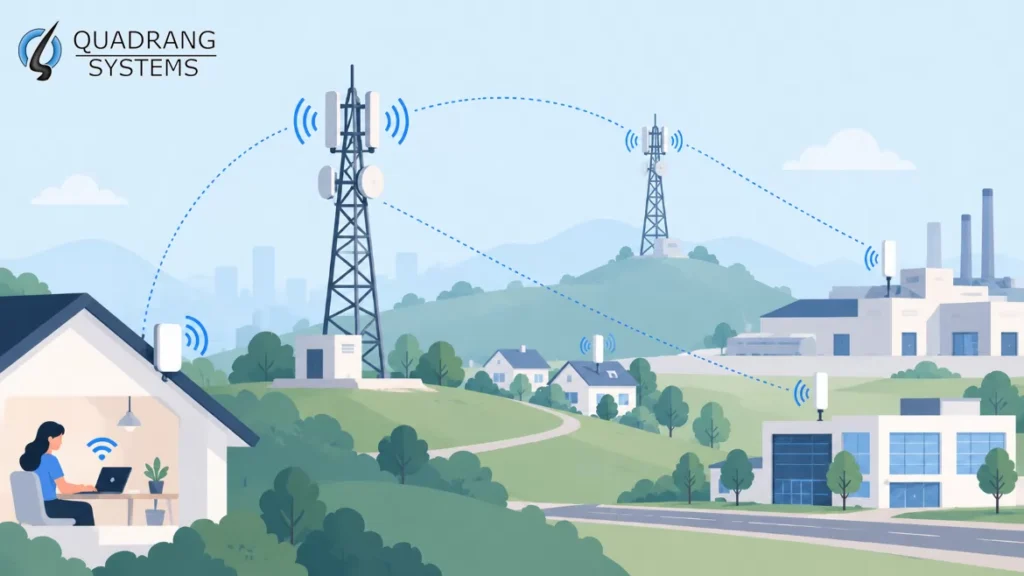
Fixed wireless internet is a broadband technology that delivers high-speed connectivity through radio waves transmitted between fixed points. Unlike mobile services built for devices on the move, FWA serves stationary locations such as homes, offices, shops, clinics, and campuses. Signals travel from cell towers, small cells, or dedicated wireless infrastructure to a receiver installed at the customer’s premises.
By 2026, FWA is built mostly on 5G, with 5G standalone (SA) cores and 5G-Advanced upgrades now rolling out across many networks. These upgrades improve capacity and efficiency, so providers can deliver consistent, fiber-like speeds in many areas without laying a single cable to each property. That matters most where trenching fiber is expensive, slow, or physically difficult.
How Fixed Wireless Internet Works
An FWA network starts with a base station or tower that connects to the wider internet backbone through fiber or microwave backhaul. The base station broadcasts radio signals across its coverage area, and the real-world range depends on frequency band, terrain, and equipment.
At the customer’s location, a receiver, either an indoor gateway or an outdoor antenna, captures the signal and converts it into usable connectivity. Most modern gateways pair the 5G radio with Wi-Fi 6E or Wi-Fi 7 routers, so the connection is distributed throughout the premises over Wi-Fi or ethernet. Outdoor units, usually mounted on a roof or exterior wall, are still the best choice for homes with weak signal.
Several technologies work together to keep performance strong:
- Beamforming and massive MIMO focus signals toward individual users and serve more of them at once.
- Carrier aggregation combines multiple frequency bands to raise speeds.
- Millimeter-wave and mid-band spectrum provide the capacity for high-speed service, with mid-band offering the best balance of speed and coverage.
- AI-driven network optimization tunes traffic and power in real time to improve quality of service.
Installation is faster and less disruptive than wired service. Many providers now ship self-install kits that customers set up in minutes. Professional installs for outdoor units typically finish within a few hours.
Advantages of Fixed Wireless Internet in 2026
FWA offers compelling benefits for consumers and businesses alike.
Rapid deployment. FWA can reach new areas within weeks of a network expansion, while fiber or cable builds can take months or years. This is especially valuable in rural and semi-urban regions.
Cost-effectiveness. Building out wireless infrastructure costs far less than fiber-to-the-home, which lets providers offer competitive pricing. Many plans now include simple, transparent pricing with no long-term contracts and no installation fees.
Scalability and flexibility. When demand grows, providers can add spectrum, upgrade base stations, or add cells without visiting individual customers. FWA also suits temporary or seasonal needs, such as construction sites, pop-up retail, events, and remote offices. Many customers also use it as a backup connection that fails over automatically if their primary line goes down.
Improved reliability. Modern FWA benefits from better spectrum utilization, network slicing on 5G SA networks, weather-hardened equipment, and stronger error correction. Business-grade plans increasingly come with service level agreements (SLAs) and prioritized traffic.
Fixed Wireless vs. Traditional Broadband Options
Fiber still delivers the best performance, with symmetrical speeds and very low latency, but it’s costly and slow to build. FWA is often the faster path to good broadband, and for many households its speeds are more than enough for streaming, remote work, and gaming.
Cable depends on extensive coaxial infrastructure and typically offers much slower upload speeds. FWA can compete on price and simplicity, though cable may offer higher peak capacity in dense areas.
Satellite has improved significantly, especially with low Earth orbit (LEO) constellations like Starlink, which now deliver respectable speeds and latency in places no terrestrial network reaches. Even so, FWA generally offers lower latency and lower costs wherever a cell tower is in range, making it the better option for real-time applications like video conferencing, cloud gaming, and VoIP. Satellite remains the stronger choice for truly remote locations.
DSL over telephone lines loses speed over distance and is being phased out in many markets. FWA delivers more consistent performance across its coverage area and has become a common replacement for aging copper networks.
Things to Consider Before Choosing FWA
FWA is not perfect for everyone. Because capacity is shared among users on the same cell, speeds can dip during peak hours in congested areas. Signal quality depends on distance from the tower and on obstructions such as buildings and dense foliage. Upload speeds, while improving, are often lower than fiber’s. Checking real-world coverage and reading local user reviews before signing up is always worthwhile.
The Future of Fixed Wireless Internet Is Bright
The outlook for FWA remains strong in 2026 and beyond. 5G-Advanced is improving capacity and efficiency, and early work on 6G is pointing toward even higher speeds and smarter networks. Wi-Fi 7 gateways are helping customers get more from the connection once it reaches their home or office.
AI-driven network management is allowing providers to serve more customers per cell while keeping quality high. Meanwhile, governments around the world continue to support FWA through spectrum policy and funding programs, recognizing it as a fast and cost-efficient way to achieve universal broadband access. In the United States, for example, federal and state broadband programs now treat fixed wireless as one of several accepted technologies alongside fiber and satellite.
Choosing the Right Fixed Wireless Provider
Selecting a provider takes some homework:
- Check coverage maps and, where possible, run a trial or speed test at your address, since signal strength can vary from one building to the next.
- Compare speed tiers and data policies, including any deprioritization during congestion, against your actual usage, from everyday browsing to 4K streaming and cloud workloads.
- Review equipment and installation options, including whether an outdoor antenna is available if indoor signal is weak.
- Look at SLAs and support quality, especially for business use where downtime is costly.
- Read the contract terms, including pricing guarantees, promotional rates, and cancellation conditions.
Conclusion
Fixed wireless internet has matured into a credible, mainstream broadband option. It offers fast deployment, competitive pricing, strong performance on modern 5G networks, and the flexibility to serve everything from rural homes to city offices. While fiber remains the gold standard where it’s available, FWA fills the gap for the many locations where fiber is out of reach, and it’s improving every year. Whether you’re in an underserved area or simply want a flexible alternative or backup connection, fixed wireless internet deserves serious consideration in 2026.
Frequently Asked Questions
What is fixed wireless internet and how does it work?
Fixed wireless internet is a broadband technology that delivers high-speed internet through radio waves between stationary points. Signals are broadcast from cell towers or base stations to a receiver at the customer’s location, which converts them into connectivity distributed through Wi-Fi or ethernet. Most of today’s services run on 5G networks.
What is fixed line internet?
Fixed line internet refers to broadband delivered through physical cables or wires connected directly to the customer’s premises, including fiber-optic, cable, and DSL. Unlike wireless services, it requires a physical connection between the provider’s network and the customer’s equipment.
What is fixed broadband internet?
Fixed broadband covers all high-speed internet services delivered to stationary locations, both wired and wireless. That includes fiber, cable, DSL, fixed wireless, and, in many definitions, satellite service for a fixed address. The word “fixed” distinguishes these services from mobile broadband on smartphones and tablets.
Why is it called fixed wireless?
“Fixed” means the service is tied to a stationary location rather than a moving device, and “wireless” means the connection uses radio waves instead of physical cables. The name separates it from mobile wireless services and from fixed line connections.
Is fixed wireless internet fast enough for streaming and gaming?
In most areas with good coverage, yes. Modern 5G FWA supports 4K streaming, video calls, remote work, and online gaming. Actual speeds depend on your distance from the tower, network congestion, and the equipment you use.
If you are an FWA ISP, contact us today to discuss available options to support your network with our managed NOC services. We are experts in providing NOC support for your cases.


