
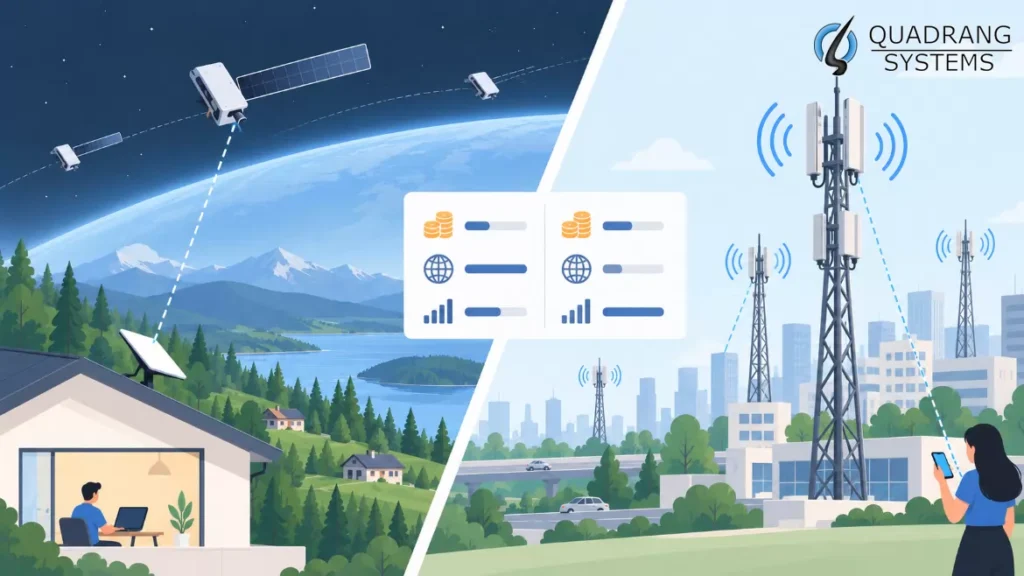
Starlink vs 5G in 2026: Which Technology Wins Your Connection?
The satellite-versus-cellular debate has changed a lot since last year. Starlink now has a much larger constellation, newer V3 satellites are arriving, and direct-to-cell service is growing. Meanwhile 5G is moving from “launched” to “upgraded”, with standalone (SA) cores and 5G-Advanced features. This guide covers what each technology offers in 2026, where each one is strongest, and how to choose.
Starlink in 2026: What Has Changed
A Much Larger Constellation
Starlink runs thousands of low Earth orbit satellites at roughly 550 km altitude. Reports put the constellation at over 10,000 satellites by early 2026, with more than 10 million subscribers worldwide. Its terminals still connect to satellites overhead, which relay traffic to ground stations (and increasingly to other satellites over laser links) before it reaches the internet backbone.
V3 Satellites, Gigabit Plans and Direct-to-Cell
Three developments matter most in 2026:
- Third-generation (V3) satellites. SpaceX targeted the first half of 2026 to begin launching them, with far higher capacity per satellite.
- Gigabit-class speeds. These are planned to roll out through 2026, starting in remote regions, and reportedly won’t need new hardware for owners of recent terminals.
- Direct-to-cell service. This brings basic satellite connectivity to ordinary phones in places with no towers.
Timelines on all three can slip, so check Starlink’s own announcements before you plan around them.
5G in 2026: From Rollout to Upgrade
Standalone 5G Is Becoming the Standard
Early 5G networks leaned on 4G cores (non-standalone, or NSA). In 2026 the story is the move to standalone (SA) 5G. Ookla and Omdia’s 2026 report put global SA adoption at about 17.6% of tested connections, with a global median SA download speed of roughly 270 Mbps. That is about 52% faster than NSA networks.
Regional results vary widely:
- South Korea: median SA speed around 767 Mbps.
- United States: around 404 Mbps.
- Europe: around 205 Mbps, with SA still a small share of connections.
- China: SA dominates (about 81% of samples), with over 10 million 5G-Advanced subscribers.
- India: SA share near 49%, driven largely by Reliance Jio’s rollout.
5G-Advanced, Slicing and Edge Computing
5G-Advanced (3GPP Release 18 features) adds better carrier aggregation, network slicing and lower latency options. Carriers are starting to sell speed tiers, enterprise SLAs and slice-based products. Spectrum bands are unchanged: low-band for coverage, mid-band for balance, and millimeter wave for peak speed in dense areas.
Quick Comparison Table: Starlink vs 5G (2026)
| Feature | Starlink | 5G |
|---|---|---|
| Typical download speed | ~65–200+ Mbps (varies by region and plan) | ~100–400 Mbps typical; 1 Gbps+ on mmWave or strong SA/5G-Advanced |
| Typical upload speed | ~10–30 Mbps | ~15–100 Mbps |
| Latency | ~25–60 ms typical (100+ ms in remote ocean and polar regions) | Single-digit ms best case on SA; tens of ms in many real-world tests |
| Coverage | Near-global (clear sky view needed) | Urban and suburban focus, expanding into rural areas |
| Mobility | Roam, maritime and aviation plans; stationary home use | Full mobile support |
| Setup cost | Hardware from roughly $300+ | Often none; 5G device may be needed |
| Monthly cost | Roughly $50 (budget/limited) up to several hundred (priority, maritime) | $10–$100 typical, depending on market |
| Best for | Rural, remote, maritime, backup | Urban, mobile, real-time apps |
| Weather impact | Moderate (heavy rain/snow) | Minimal; mmWave is sensitive to obstructions |
| Data caps | Varies by plan; lower tiers may be deprioritized | Often “unlimited” with fair-use limits |
| Installation | DIY or professional | Plug and play |
Figures are ranges from public tests and vendor information. They vary by country, plan and time of day.
Speed and Performance in 2026
Download and Upload
Starlink’s median US download speeds in public tests sit in the tens to low hundreds of Mbps, with European medians reportedly higher. Upload speeds have improved, typically landing at 10–30 Mbps. Peak-hour congestion has been easing as V3 capacity comes online, though results still depend heavily on your location and plan tier.
5G performance depends on spectrum and architecture. Mid-band SA networks with carrier aggregation are delivering the biggest real-world gains, while mmWave still peaks above 1 Gbps in very limited areas.
Latency
Latency remains 5G’s advantage. Starlink’s typical 25–60 ms is fine for streaming, video calls and most gaming, but it can’t match the best-case 5G SA response times. In practice, many 5G tests still measure well above the theoretical 1–10 ms, so check real-world results for your carrier.
Coverage and Accessibility
Starlink covers more of the world than any terrestrial network can. By mid-2026 it lists service in well over 100 countries and territories, with more scheduled. For rural communities, ships, aircraft and temporary sites, it is often the only high-speed option.
5G continues to follow population density. Coverage in cities is mature, and many carriers are now strengthening indoor coverage and capacity rather than just adding towers. Rural 5G is improving but remains patchy in many markets, which is where Starlink and direct-to-cell services fill in.
Mobility is the other split. 5G works seamlessly while you travel, while Starlink’s best experience is still a fixed dish. Its roam, maritime and aviation options are now far more established than a year ago.
Cost and Economic Considerations
Starlink pricing has broadened. Budget residential plans start around $50 a month with hardware near $300 in some markets (often with lower priority), while standard, priority, roam and maritime tiers cost considerably more. Prices and plan names change often and differ by country, so confirm locally.
5G is usually bundled into existing mobile plans, with unlimited premium plans commonly in the $50–$100 range in high-income markets and much less elsewhere. A compatible phone or router may be needed, and some carriers now charge extra for premium speed tiers or slicing features.
For businesses, total cost of ownership includes equipment, installation, SLAs, redundancy and support, not just the monthly fee.
Real-World Applications and Use Cases
Starlink fits best for:
- Rural homes and businesses without fiber or reliable broadband
- Emergency response, field research and disaster recovery
- Maritime, aviation and remote-site operations
- Backup connectivity for critical infrastructure
5G fits best for:
- Smartphones and anything that moves
- Smart city, industrial IoT and private networks
- Fixed wireless access (5G home broadband) in covered areas
- Latency-sensitive uses such as cloud gaming, AR and connected vehicles
Many organizations now run both: 5G as the primary link and Starlink as failover, or the reverse at remote sites.
Future Outlook
Starlink’s priorities are V3 capacity, lower latency (a roughly 20 ms median is the stated ambition), gigabit tiers and wider direct-to-cell coverage. Its biggest dependency is launch cadence, especially Starship’s progress.
5G is heading deeper into SA, 5G-Advanced and monetized slicing, while early 6G research and standards work shape the roadmap toward the end of the decade. Satellite and terrestrial networks are also converging, with direct-to-device services blurring the line between them.
Making the Right Choice
- Rural or remote, no fiber: Starlink is usually the strongest option.
- Urban or suburban, mobile-first: 5G, ideally on a carrier with SA and good mid-band coverage.
- Mission-critical operations: use both for redundancy.
- Latency-sensitive workloads: prefer 5G SA or fiber.
- Already have fiber or good cable: keep it; neither technology is aiming to beat it on price or stability.
Before buying, check independent speed-test data for your area, current plan prices, and your sky view (Starlink) or indoor signal (5G).
For expert guidance on implementing either technology or managing complex network operations, contact Quadrang Systems for professional 24/7 Network Operations Support services tailored to your specific requirements.
Frequently Asked Questions
Is Starlink better than 5G?
It depends on location. Starlink wins where terrestrial coverage is weak or missing, while 5G generally offers lower latency and better mobility in covered areas.
Is Starlink better than mobile data?
In remote areas, yes: it’s often more consistent. But it lacks the portability of a phone plan, and direct-to-cell services are only beginning to narrow that gap.
What is faster than Starlink?
Fiber, strong mid-band or mmWave 5G, and 5G-Advanced networks can all exceed typical Starlink speeds. Gigabit-class Starlink tiers are planned but not yet widespread.
Is Starlink better than 4G?
Usually on speed, yes, but with higher latency and cost. In areas with good 5G or strong 4G, cellular may be the better value.
Can Starlink replace my mobile network?
Not fully. Direct-to-cell adds basic coverage where there are no towers, but it complements rather than replaces terrestrial 5G.


